WHEW! We've had an exciting couple of weeks: March madness, oyster eating, visits from out of town friends, After Midnight broadway show, and celebrating my birthday with my family. Wow... I don't know where to begin, so I'll begin by describing more of our Met adventures.
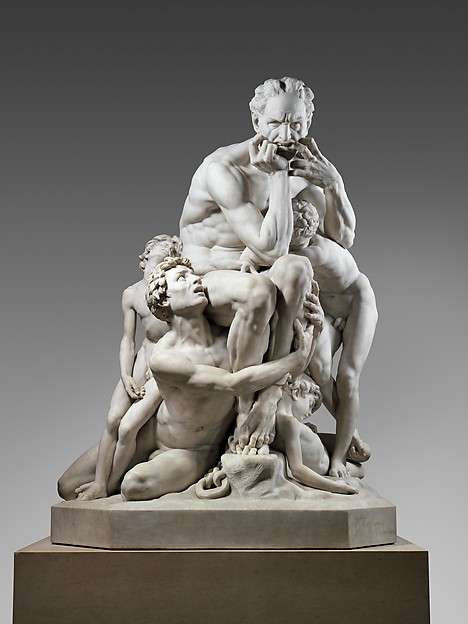
Last week we went to see the special exhibit "The Passions of Jean-Baptiste Carpeaux" who was an amazing French sculpture during the 19th century. It was neat to see the sketches and self-portraits that were included in this retrospective that showed he was a versatile artist and could work in many media. Unfortunately, they didn't allow us to take pictures - otherwise I would overwhelm you with this post - but they did have Ugolino and His Sons on display, which is in the Met's permanent collection, so I don't feel bad about sharing their photo of it here.

This week we made some serious damage to the map by visiting one of the rooms in Decorative Arts AND visiting the entirety of the Ams and Armor gallery.
Starting in the Robert A. Ellison Jr. collection of French ceramics, we saw some amazing sculptures made from ceramics.

The glazes that were used were so interesting - these vases had details that you could just get lost in. What was really cool was that they put the French ceramics near other objects in the museum's collection that might have been inspiration. The above picture shows both a 19th century French ceramic and Qing Dynasty Chinese that could have been its inspiration.


We then took a pause to check out the guitar busker who was here for this month's performance in connection with the Martin Guitar show. Tim Farrell is a very lovely, relaxed guitar soloist, whose music filled the expansive and echoey Englehard Court.

And since we were so close, we used it as an opportunity to visit the Arms and Armor gallery. I'll be honest - I walked into the gallery quite biased against it. I didn't want to see instruments of war; I just didn't care. But I am so thankful that this challenge forced me to swallow my prejudice and just try something I wasn't expecting to like... because I loved this gallery.

Many of the pieces were ceremonial, and therefore were unlikely to have actually been worn in battle, but I was just blown away by how intricate some of the details on these pieces were. So, yes, if you just glance at the cases in these galleries - like I had done on every other one of my visits to the Met - you would completely miss how awesome their collection is.


We also couldn't come to this gallery without the obligatory 'scale-setting' photo op with Henry VIII's suit of armor.

Maybe the only mild disappointment was that the galleries were divided, literally, in half by the West and the Rest. And while it did have some amazing artifacts from places that weren't Europe, the collection didn't feel as complete.


Another interesting discover was these katana embellishments that were made by the same Goto master that made the Musical Instruments collection's stunning koto. It very truly is a small world.


The most delightful part of the gallery was the small area that served as a tribute to the original curator of the Arms and Armor galleries, Bashford Dean. He's pictured below wearing one of their recent acquisitions, which is something he enjoyed doing with some frequency. He was a polymath, working for the both the Met and the Natural History Museum, where he was the first curator of the Department of Reptiles and Fishes. Here are two articles that the Met wrote about this amazing character.

So we're making great progress on the map. Looking forward to more weeks of "work" to come!

Last week we went to see the special exhibit "The Passions of Jean-Baptiste Carpeaux" who was an amazing French sculpture during the 19th century. It was neat to see the sketches and self-portraits that were included in this retrospective that showed he was a versatile artist and could work in many media. Unfortunately, they didn't allow us to take pictures - otherwise I would overwhelm you with this post - but they did have Ugolino and His Sons on display, which is in the Met's permanent collection, so I don't feel bad about sharing their photo of it here.
Sculpture of the tormented Ugolino
Week 5 map, making progress
This week we made some serious damage to the map by visiting one of the rooms in Decorative Arts AND visiting the entirety of the Ams and Armor gallery.
Starting in the Robert A. Ellison Jr. collection of French ceramics, we saw some amazing sculptures made from ceramics.

The glazes that were used were so interesting - these vases had details that you could just get lost in. What was really cool was that they put the French ceramics near other objects in the museum's collection that might have been inspiration. The above picture shows both a 19th century French ceramic and Qing Dynasty Chinese that could have been its inspiration.
We then took a pause to check out the guitar busker who was here for this month's performance in connection with the Martin Guitar show. Tim Farrell is a very lovely, relaxed guitar soloist, whose music filled the expansive and echoey Englehard Court.
And since we were so close, we used it as an opportunity to visit the Arms and Armor gallery. I'll be honest - I walked into the gallery quite biased against it. I didn't want to see instruments of war; I just didn't care. But I am so thankful that this challenge forced me to swallow my prejudice and just try something I wasn't expecting to like... because I loved this gallery.
Transporting you back in time
At a glance, this will never seem quite as impressive as...
... the details you can see when you come closer.
The devil is in the details
Oh, you like this pattern I have in my armor? Yeah, this happened
Shields offered some impressive storytelling opportunity
Even the firearms were beautiful. I'm not a fan of guns myself, but it was hard not to be impressed with the level of detailing that was included within the constrained surface of these guns.
We also couldn't come to this gallery without the obligatory 'scale-setting' photo op with Henry VIII's suit of armor.
Much wider than he was tall
Maybe the only mild disappointment was that the galleries were divided, literally, in half by the West and the Rest. And while it did have some amazing artifacts from places that weren't Europe, the collection didn't feel as complete.
Shield from Mugal India
Persian warrior with fully armored horse
Amazing inlaid etching on these swords
Another interesting discover was these katana embellishments that were made by the same Goto master that made the Musical Instruments collection's stunning koto. It very truly is a small world.
The most delightful part of the gallery was the small area that served as a tribute to the original curator of the Arms and Armor galleries, Bashford Dean. He's pictured below wearing one of their recent acquisitions, which is something he enjoyed doing with some frequency. He was a polymath, working for the both the Met and the Natural History Museum, where he was the first curator of the Department of Reptiles and Fishes. Here are two articles that the Met wrote about this amazing character.
So we're making great progress on the map. Looking forward to more weeks of "work" to come!

No comments:
Post a Comment